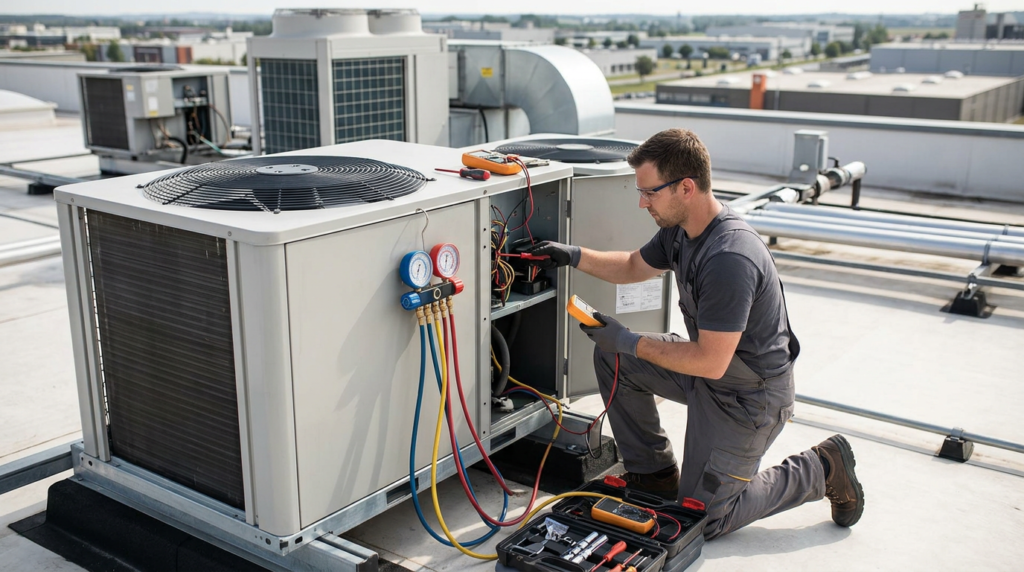
Quick answer: Call a licensed commercial HVAC contractor that regularly services your equipment type in DuPont. Choose one that provides clear service documentation (readings, root cause, next steps), offers emergency/after-hours coverage, can troubleshoot controls and economizers, can support commercial refrigeration if your site needs it, and will coordinate safely with your building’s access rules and schedule to minimize downtime.
What “Commercial HVAC Service” Usually Includes
Commercial HVAC service usually falls into three buckets: diagnostics, maintenance, and replacement/project work. Diagnostics is the “find it fast and fix it right” part—confirming the complaint, checking airflow and filtration, inspecting belts and bearings, verifying safeties, and testing electrical components like contactors, capacitors, and relays. For cooling issues, it also means evaluating coil condition, refrigerant performance, and economizer operation when equipped.
Maintenance is the scheduled work that prevents breakdowns: filter changes, coil cleaning, drain line checks, tightening electrical connections, and confirming thermostat/control sequences. If you’re searching specifically for DuPont commercial HVAC services, ask how maintenance findings are documented so recurring issues (like nuisance trips or chronic hot spots) don’t get treated as one-off calls.
Replacement/project work covers planned fixes and upgrades: rooftop unit swaps, curb adapters, duct transitions, control upgrades, and coordinating any required permits. Some contractors also support light commercial refrigeration (walk-ins, reach-ins, ice machines) as part of the same service relationship.
DuPont-Specific Considerations for Commercial HVAC Calls
In DuPont, a practical differentiator is how well a contractor coordinates the “site logistics” that slow commercial jobs down. For larger replacements or new equipment, ask who handles permitting and inspection coordination with local requirements, and how they schedule around tenant access, roof access rules, and any safety policies your property manager enforces.
After-hours work is common for local retail, restaurants, and multi-tenant buildings because shutting down a space during business hours can be more expensive than the repair itself. A good provider will confirm access windows, alarm procedures, and who can authorize work before dispatching a technician so you don’t lose time at the door or on the roof.
South Puget Sound weather also affects what “normal” looks like. Humidity and shoulder-season swings can expose economizer and control-sequence problems (too much outside air, stuck dampers, or poor dehumidification). Asking about controls and economizer diagnostics is especially relevant when comfort complaints show up on mild, damp days rather than only during peak heat or cold.
Signs You Need Service Now (Not “Next Month”)
Some symptoms justify an immediate call: repeated breaker trips, burning smells, loud screeching or grinding, or water pooling around equipment. Those can point to electrical faults, failing motors, or blocked drains that can escalate into bigger damage and downtime.
Short cycling (rapid on/off) is another red flag. It can be caused by airflow restrictions, control issues, or refrigerant-related problems that strain compressors. Comfort patterns help narrow it down: persistent muggy zones, chronic hot/cold spots, or a system that can’t keep up during mild weather often suggest airflow balance, economizer/damper actuator failures, or control-sequence issues rather than a simple “needs refrigerant” diagnosis.
For refrigeration, warm product temps, heavy frost, or unusually long run times can indicate dirty coils, fan failures, defrost problems, or door gasket leaks. If food safety or critical rooms are involved, ask about temporary stabilization steps while parts are sourced.
What to Ask and What to Have Ready Before You Call
On the phone, ask: Do you service my equipment type and brand? Can you support controls/economizers? Do you offer emergency or after-hours response? Do you handle commercial refrigeration if I have it? How do you document readings and recommendations? Also confirm scheduling expectations and who approves work on your site.
Have ready: the equipment model/serial (data plate on the unit), a clear symptom description and when it started, whether it’s constant or intermittent, any recent changes (construction, thermostat adjustments, new operating hours), and site constraints like roof access rules, ladder requirements, and after-hours entry procedures. If you have a building automation system, provide alarm history or screenshots.
A good service ticket should include measured readings (temperatures, pressures where applicable, amperage/voltage checks), what was inspected, the identified root cause, what was repaired or adjusted, parts used, and a short list of recommended next steps with priority (safety, reliability, efficiency).